AgentArk: Distilling Multi-Agent Intelligence
into a Single LLM Agent

1Carnegie Mellon University 2William & Mary 3Georgia Institute of Technology 4Amazon 5University of British Columbia
* Corresponding authors
+4.8% Avg. accuracy lift over single-agent baseline
120 Experiments across Qwen3, Gemma 3, Llama 3
3 Distillation strategies: R-SFT · DA · PAD
~342K Distillation questions, ~2M reasoning trajectories
01 · Overview

Abstract

While large language model (LLM) multi-agent systems achieve superior reasoning performance through iterative debate, practical deployment is limited by their high computational cost and error propagation. This paper proposes AgentArk, a novel framework to distill multi-agent dynamics into the weights of a single model, effectively transforming explicit test-time interactions into implicit model capabilities. This equips a single agent with the intelligence of multi-agent systems while remaining computationally efficient. Specifically, we investigate three hierarchical distillation strategies across various models, tasks, scaling, and scenarios: reasoning-enhanced fine-tuning; trajectory-based augmentation; and process-aware distillation. By shifting the burden of computation from inference to training, the distilled models preserve the efficiency of one agent while exhibiting strong reasoning and self-correction performance of multiple agents. They further demonstrate enhanced robustness and generalization across diverse reasoning tasks. We hope this work can shed light on future research on efficient and robust multi-agent development. Our code is at github.com/AIFrontierLab/AgentArk.

02 · Motivation

From a debating crowd to a single thinker

Multi-agent debate produces strong reasoning but is slow and brittle. AgentArk compresses the dynamics of an agent ensemble into the weights of one model — preserving the collective behavior at single-agent inference cost.
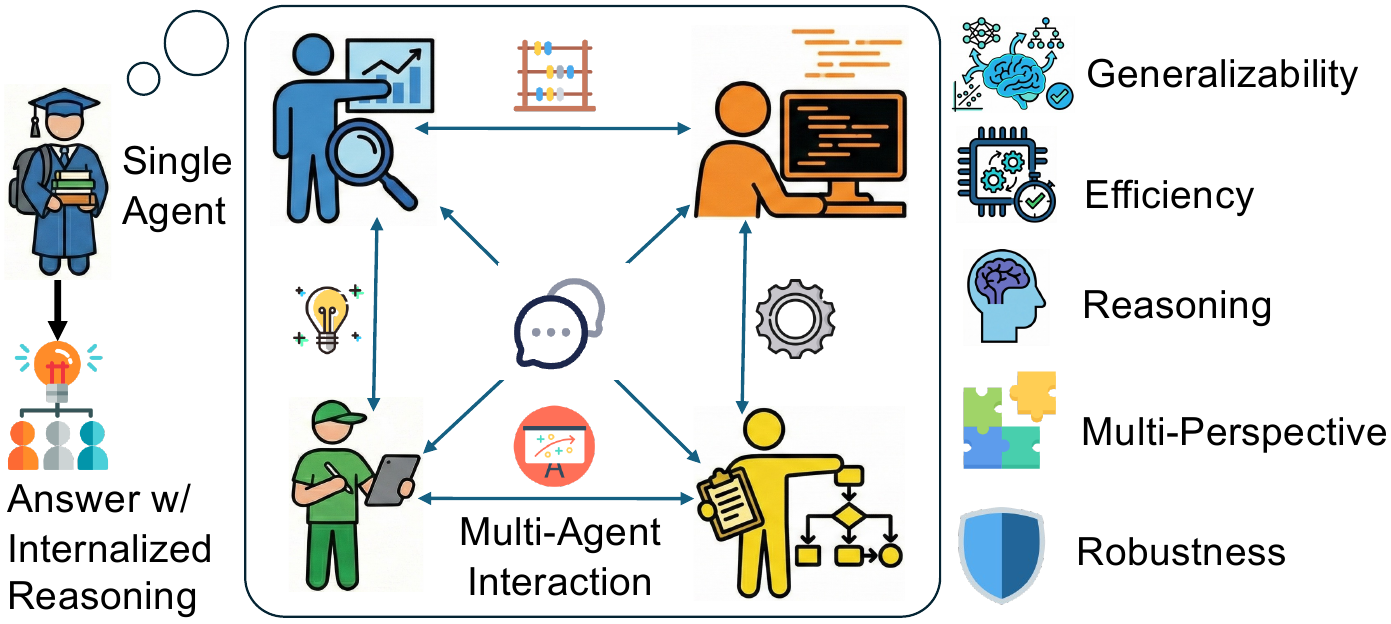
AgentArk teaser: distilling multi-agent reasoning into a single agent

AgentArk distills the reasoning capability of a multi-agent system into a single agent, so that one unit imitates the collective thinking process with boosted performance and a fraction of the inference cost.
03 · Contributions

What AgentArk delivers

First MAS-distillation study

To our knowledge, the first comprehensive framework that explores and compares multiple strategies for distilling multi-agent reasoning into a single model.

Scalable, MAS-agnostic pipeline

A reusable data-generation and distillation pipeline that is agnostic to the underlying MAS algorithm, enabling research on any interaction protocol.

Extensive empirical evaluation

120 experiments across Qwen3, Gemma 3, and Llama 3 families, covering math, medical QA, long-form QA, scaling, robustness, and multimodal transfer.

04 · Framework

The AgentArk pipeline

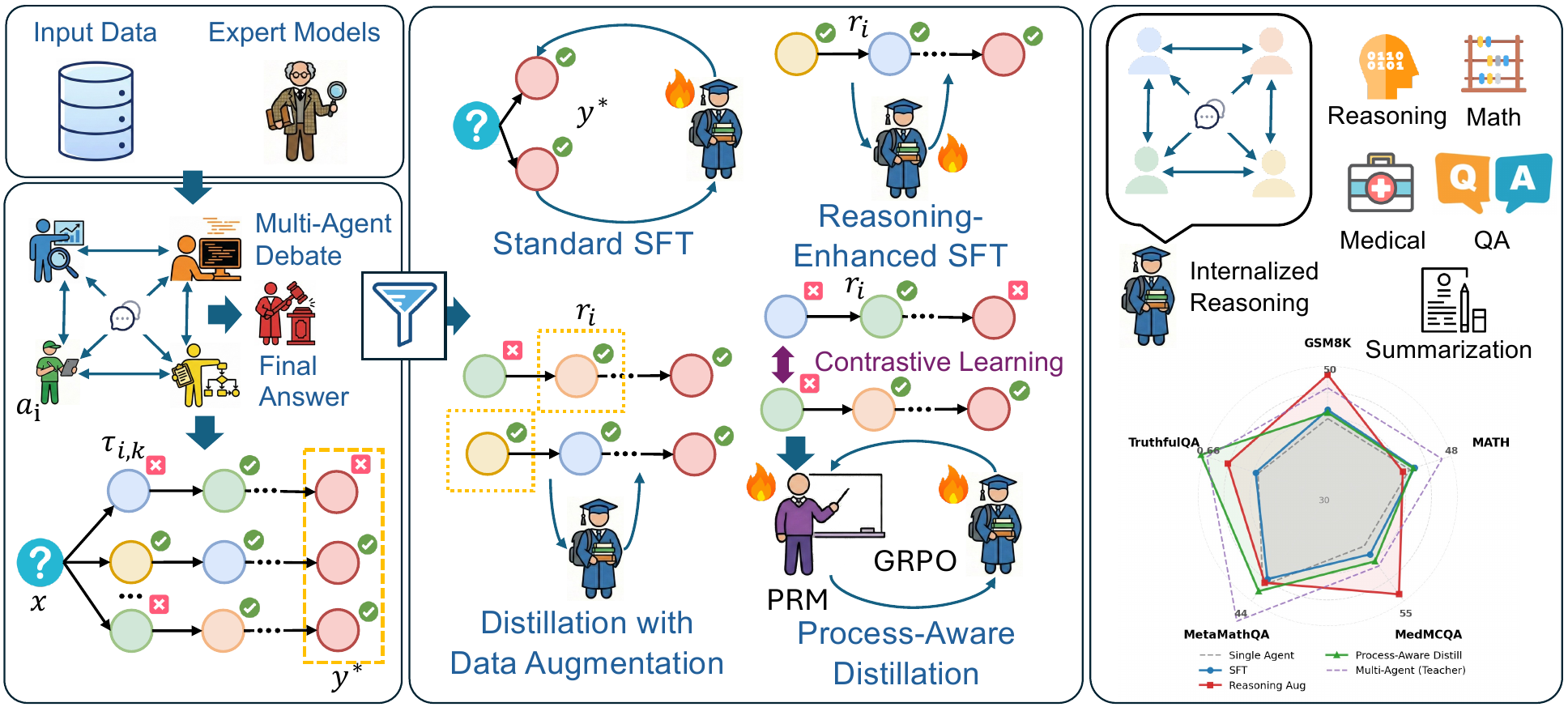
Three stages: multi-agent debateknowledge extractionhierarchical distillation.

AgentArk pipeline: multi-agent debate, knowledge extraction, and three distillation strategies

The pipeline proceeds through (1) multi-agent debate that produces diverse reasoning trajectories, (2) knowledge extraction that filters corrective traces with a high-capacity verifier (Qwen2.5-72B), and (3) three distillation routes: reasoning-enhanced SFT, trajectory-based data augmentation, and process-aware distillation with a PRM and GRPO.

05 · Strategies

Three distillation strategies

R-SFTReasoning-Enhanced Supervised Fine-Tuning

Supervise the student on both the final consensus answer and the reasoning trace that produced it. A reasoning loss trains coherent intermediate rationales, while an answer loss grounds the final prediction in those rationales.

DADistillation with Trajectory Augmentation

For every problem, extract multiple answer-consistent but structurally diverse reasoning chains from the debate log. The student learns several valid paths to the same answer, improving robustness and generalization.

PADProcess-Aware Distillation (PRM + GRPO)

Train a Process Reward Model with a contrastive step-level objective, then fine-tune the student with Group Relative Policy Optimization. This internalizes the dialectical critique-and-revision behavior of multi-agent debate within a single forward pass.

06 · Results

Single-agent performance, multi-agent quality

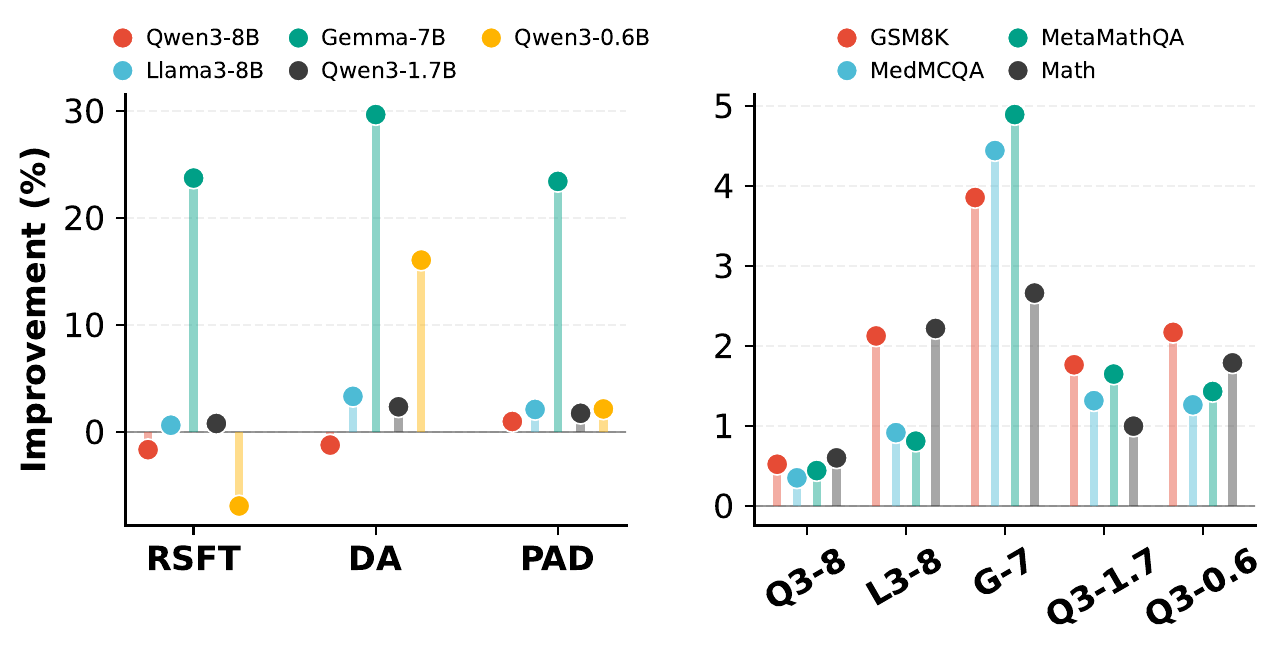
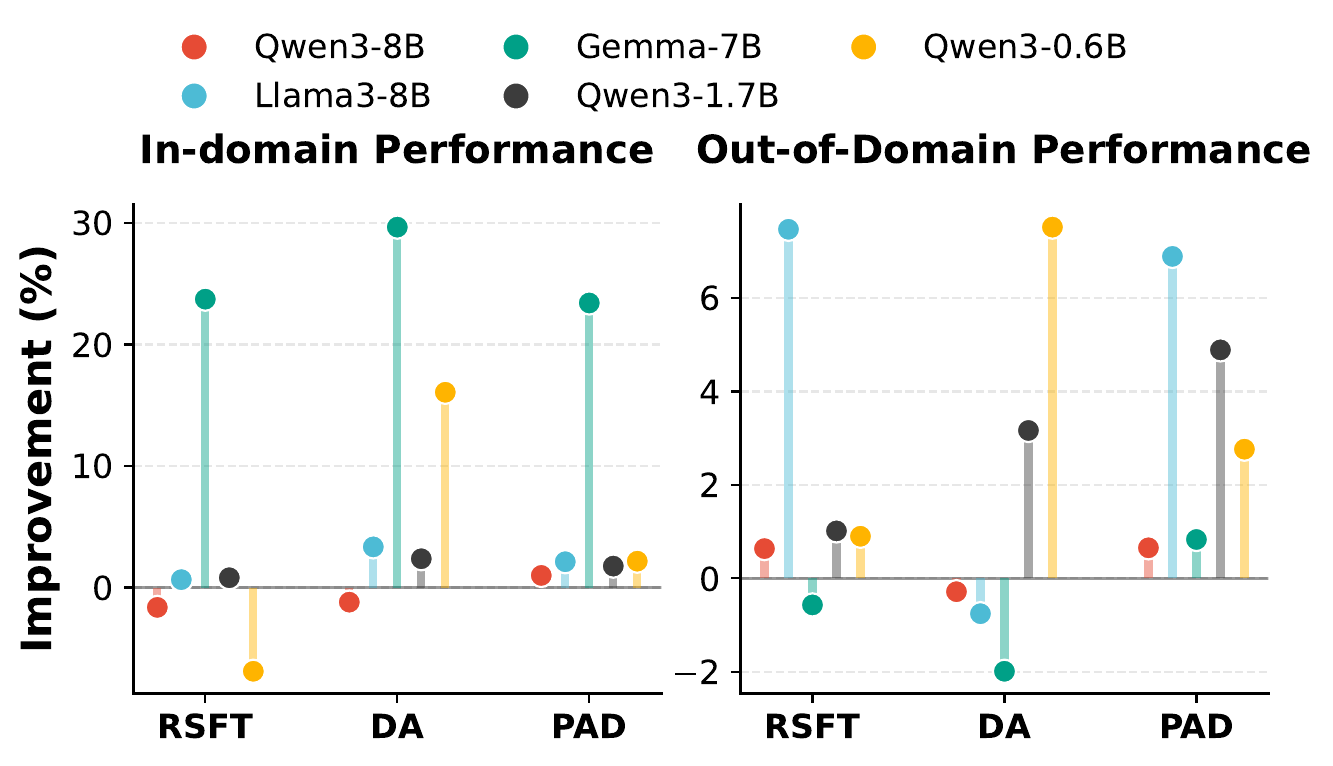
Distilling Qwen3-32B into smaller students across GSM8K, MATH, MetaMathQA, and MedMCQA, AgentArk lifts single-agent accuracy by +4.8% on average — only marginally below a full multi-agent system, at a small fraction of the inference cost.
Performance on in-domain and OOD datasets
In-domain (left) vs. OOD (right). Gains are larger ID; PAD transfers most reliably to OOD.
Performance across datasets and student models
Effects vary by dataset and student; reasoning-heavy benchmarks (MetaMathQA, GSM8K) benefit most.

PAD is most consistent

R-SFT and DA sometimes help but swing by dataset. PAD's step-level supervision delivers stable gains across settings.

Cross-family helps more

Distilling across families (Qwen → Gemma / Llama) yields larger and more consistent gains than same-family distillation.

Reasoning-heavy tasks win

Biggest lifts on MetaMathQA and GSM8K; smaller on knowledge-heavy MedMCQA — distillation transfers reasoning, not facts.

07 · Findings

Six findings from 120 experiments

F1 A single agent can acquire multi-agent reasoning.

All three reasoning-centric distillation methods boost single-agent performance, and combining them yields further gains.

F2 PRM capacity matters more than student size.

Strong PRMs lift even small students; weak PRMs limit everyone. Scaling teacher agents mostly helps larger students, with diminishing returns on small ones.

F3 Reasoning quality outweighs quantity.

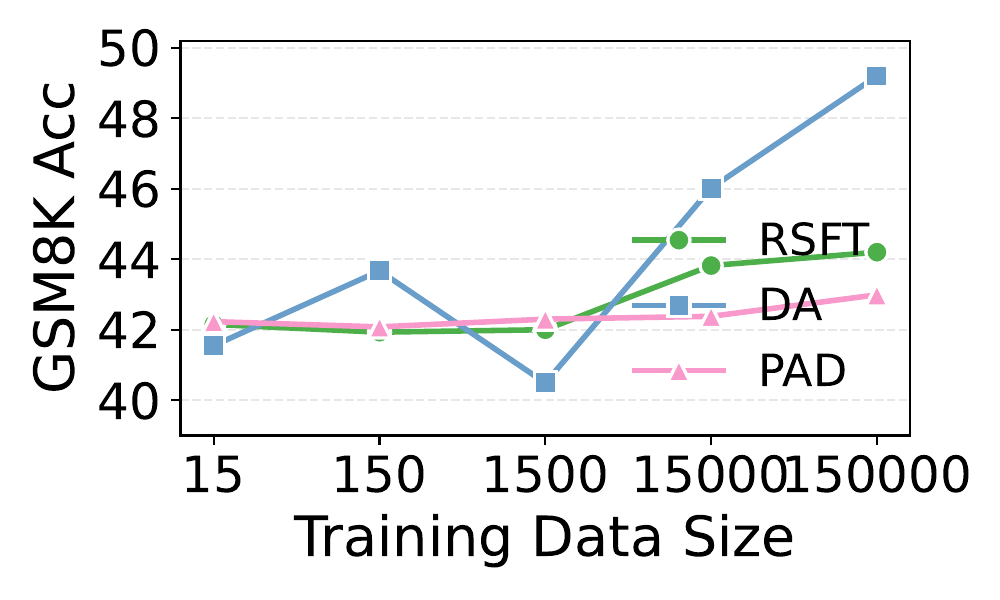
Simply adding more trajectories does not improve performance; PAD's high-signal process supervision yields stable, consistent gains.

F4 PAD improves reasoning behavior, not just accuracy.

PAD-distilled models show better step decomposition, intermediate self-checking, and error correction than R-SFT and DA.

F5 Generalization & robustness improve.

Distilled models transfer reliably to unseen reasoning benchmarks (HotpotQA, QASPER, QMSum) and robustness evaluations such as TruthfulQA.

F6 AgentArk extends to multimodal LLMs.

Despite training on text-only reasoning data, the distilled behaviors transfer to Qwen2.5-VL, suggesting modality-agnostic reasoning transfer.

08 · Scaling

Scaling & data dynamics

Reasoning quality beats data volume.

Bigger teacher ensembles mainly help larger students; for smaller ones, high-signal process supervision matters more than raw trajectory count.

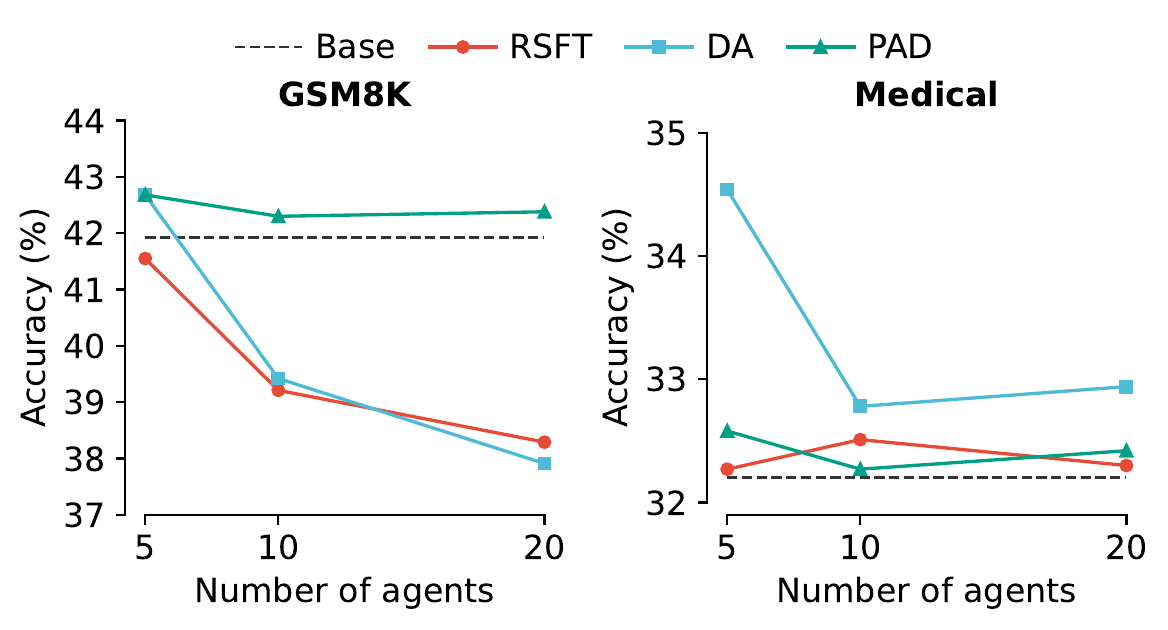
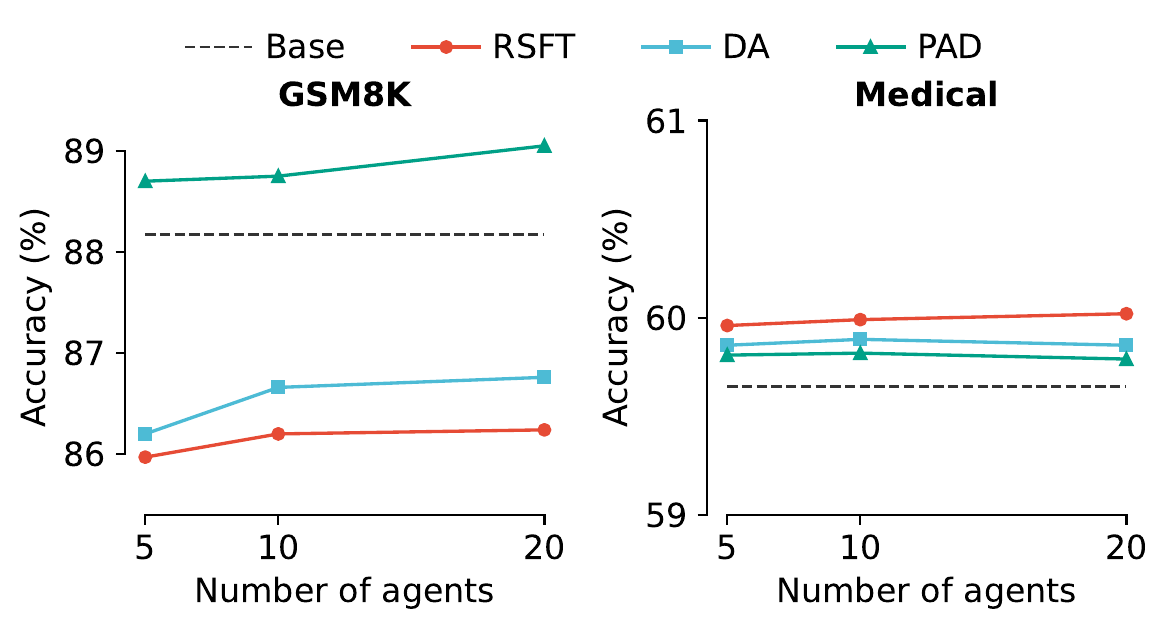
Scaling the number of debating agents

Effect of agent scale on 0.6B student
Qwen3-0.6B saturates around 5 agents; more agents can hurt due to limited capacity.
Effect of agent scale on 8B student
Qwen3-8B benefits from 5 → 10 → 20 agents, with diminishing returns.

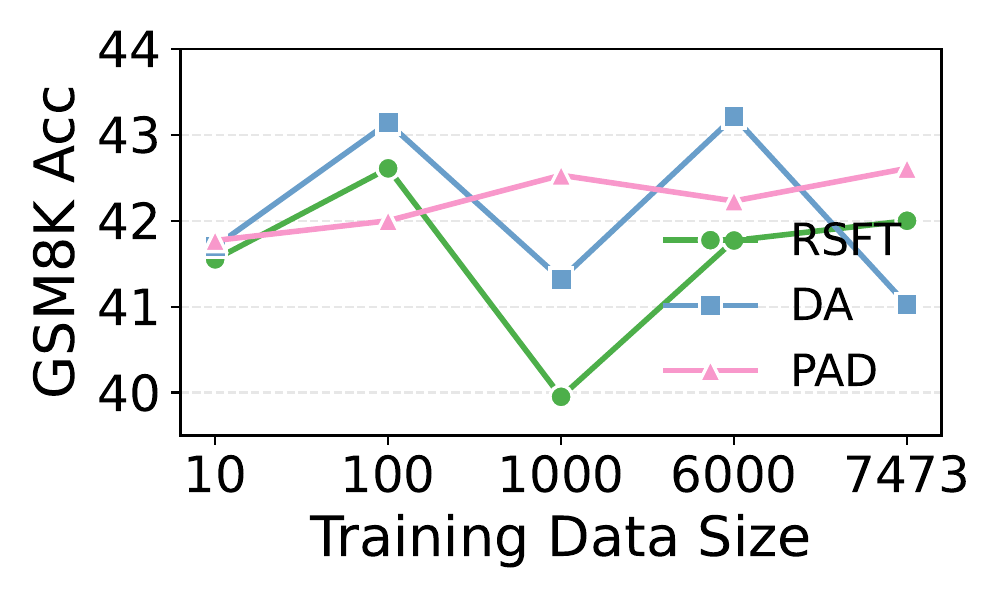
Data quantity vs. quality

Data scaling on GSM8K
GSM8K: R-SFT and DA fluctuate with scale; PAD remains stable.
Data scaling on MetaMathQA
MetaMathQA: PAD preserves high-signal trajectories instead of overwhelming the student.
09 · Quality

How distilled models actually reason

Reasoning-token perplexity on held-out GSM8K drops substantially after distillation, indicating more structured chains of thought. An LLM-judge evaluation (InternLM-2.5-20B-Chat) scores models on step decomposition, intermediate verification, error localization, and overall coherence.

PADBest on all four reasoning-quality dimensions

PAD preserves explicit multi-step structure, self-checking behavior, and coherent reasoning flows, outperforming the base and both SFT variants.

DAModerate gains on verification & error localization

DA captures surface-level reasoning structure but does not fully inherit reflective self-correction behavior.

R-SFTSmaller, less consistent improvement

Direct reasoning-level supervision alone is insufficient — it improves fluency but not the dialectical dynamics of MAS.

10 · Generalization

Robustness & cross-domain transfer

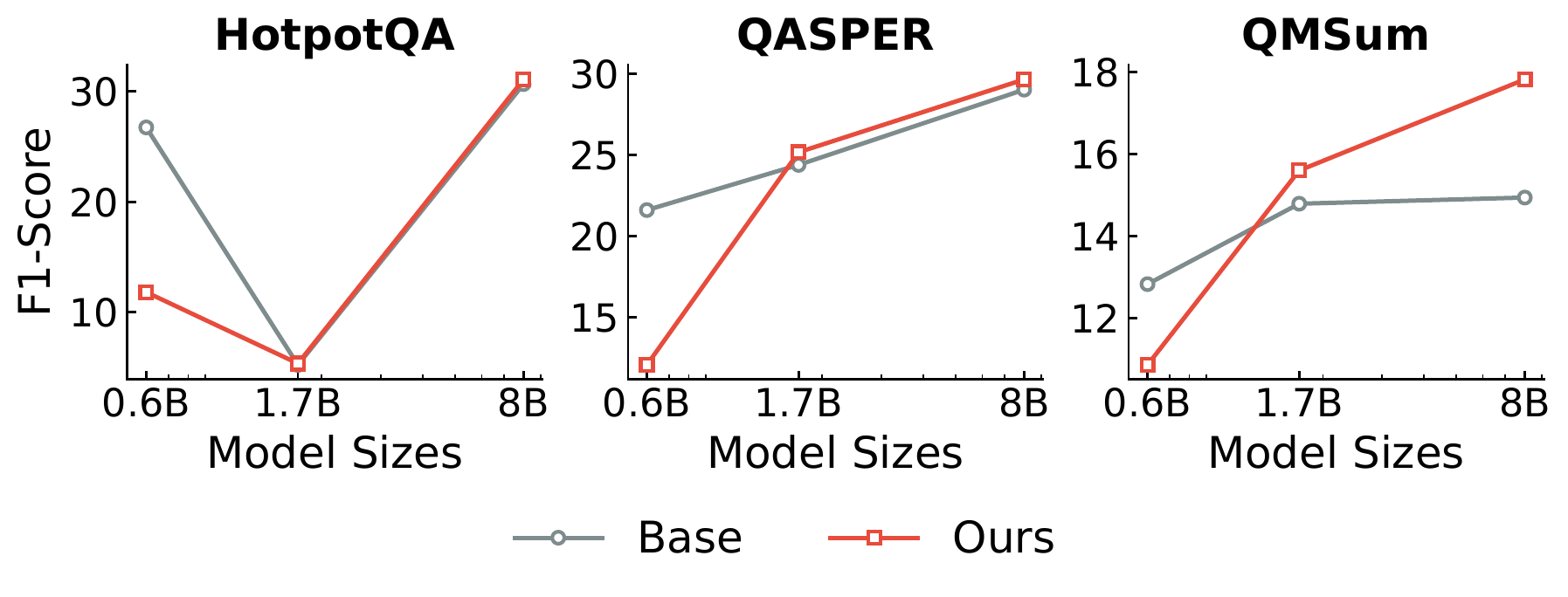
Students trained only on GSM8K transfer to HotpotQA (multi-hop QA), QASPER (long-context understanding), and QMSum (summarization) — tasks far from the training distribution.

Open-ended generalization F1 scores on HotpotQA, QASPER, and QMSum

F1 on three open-ended OOD benchmarks. AgentArk boosts cross-domain reasoning transfer, especially for larger students — distillation strengthens general reasoning rather than fitting dataset patterns.

Distilled behaviors survive distribution shift.

On TruthfulQA, all three distillation variants improve factual robustness over the base student, with PAD ranking highest — evidence that MAS distillation transfers reasoning behavior, not surface alignment.

11 · Multimodal

Extension to multimodal LLMs

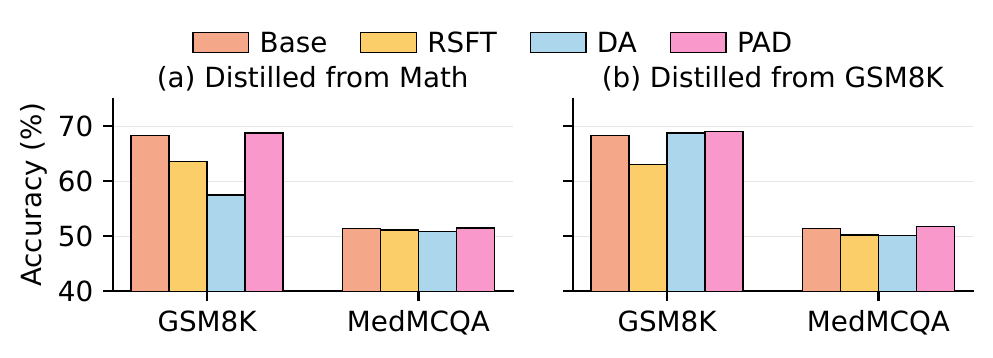
Although training data is entirely text, distilling Qwen2.5-VL-32B-Instruct into Qwen2.5-VL-3B-Instruct via the same pipeline still improves multimodal reasoning. PAD remains the strongest or near-strongest across benchmarks, suggesting AgentArk captures modality-agnostic reasoning patterns.

Multimodal distillation results on Math and GSM8K

Multimodal distillation on Math-derived and GSM8K-derived data, evaluated on Qwen2.5-VL-3B-Instruct. Gains are smaller than in text-only settings, as expected, but consistent.

12 · Cite

BibTeX

agentark.bib
@article{luo2026agentark,
  title={AgentArk: Distilling Multi-Agent Intelligence into a Single LLM Agent},
  author={Luo, Yinyi and Jin, Yiqiao and Yu, Weichen and Zhang, Mengqi and Kumar, Srijan and Li, Xiaoxiao and Xu, Weijie and Chen, Xin and Wang, Jindong},
  journal={arXiv preprint arXiv:2602.03955},
  year={2026}
}